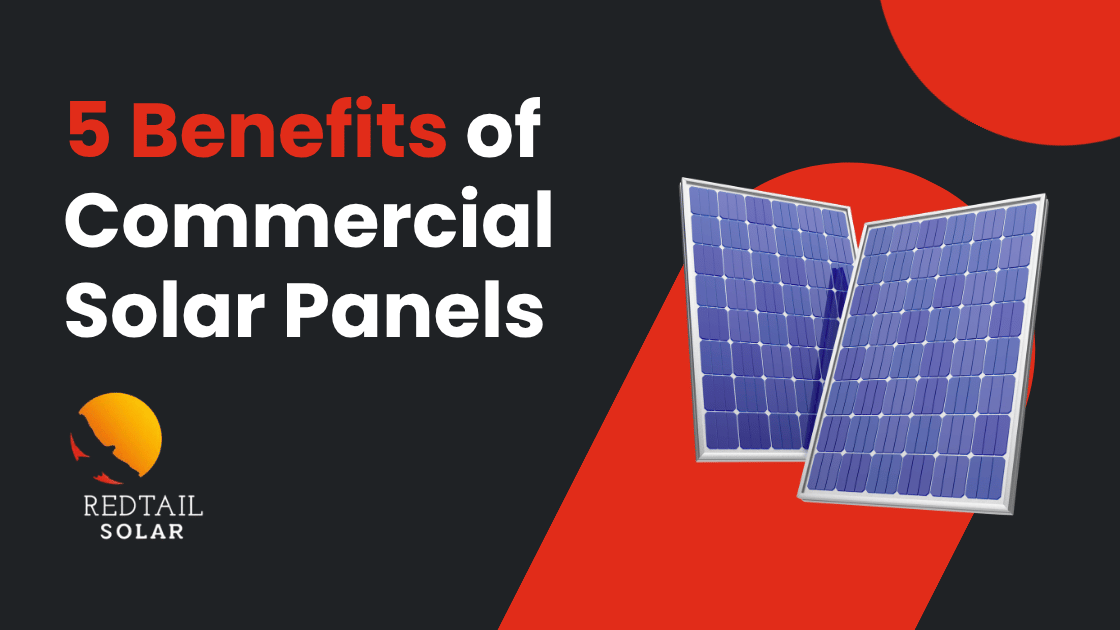
Installing commercial solar panels is about more than just producing sustainable electricity. Solar truly transforms how your business or operation manages the recurring expense of electricity. Solar panel installation for commercial facilities can help businesses cut down on their energy costs, control peak demands, be more resilient, and use their property more efficiently.
Here are 5 benefits of solar panels for commercial organizations.
Commercial Solar Benefit 1: Cut More Than Your Kilowatt-Hour Consumption
Commercial electric bills are generally more complex than household bills. Businesses may pay for the overall quantity of electricity they consume, and their peak demand, measured in kilowatts.
One of the largest components of a commercial power bill is the demand charge. According to the Pennsylvania Department of Community and Economic Development, commercial demand charges can make up anywhere from 10% to 50% or more of a customer’s entire bill, depending on the rate structure.
Installing commercial solar panels can lower the amount of electricity a company needs to buy during the day. When designed properly, solar combined with battery storage also manages when you pull electricity from the grid, which can help lower those expensive demand spikes. That makes commercial solar far less about simply producing electricity and more about managing how a commercial organization uses and purchases electricity.
Commercial Solar Benefit 2: Convert an Empty Roof into a Power-Generating Asset
A big commercial roof is valuable real estate, but it often doesn’t provide income on its own. Commercial solar panels may make that unused area work for you.
Solar panel installation for commercial facilities is often done on large roof areas of warehouses, manufacturing facilities, agricultural buildings, offices, retail businesses, and other commercial buildings. Ground-mounted solar panels for commercial properties can also make sense when a suitable property has available land.
Rather than allowing your roof to sit empty on your commercial building, you can actually use your roof to your benefit by setting it up to work for you with energy production through solar panels.
Commercial Solar Benefit 3: Make Energy Costs More Predictable
Utility rates often change, and those changes are almost guaranteed over time, so it’s hard for businesses to know what they’ll be paying for power several years from now. Commercial solar panels give a company the ability to generate some of its own power instead of buying it all from the utility.
This ability can be especially advantageous for firms that consume energy in a steady manner during the day. For example, a manufacturing firm that runs equipment all day long can use much of the electricity generated by its solar system in real time. The lower the exposure to utility electricity prices, the more predictable the energy costs will become over time.
Commercial Solar Benefit 4: Strengthen Your Position with Customers and Partners
Many companies are asking other business partners to document their energy use and environmental impact. For some commercial organizations, demonstrating a measurable progression toward energy goals can strengthen bids and be supportive for future contract renewals.
Commercial solar panels provide a visible, trackable investment that can be supported with actual electricity-production data. This gives a business something more concrete to report than a general sustainability pledge. It may also make a commercial property more attractive to tenants whose organizations have their own energy-performance standards.
Commercial Solar Benefit 5: Use Financial Incentives to Your Benefit
Commercial solar systems are eligible for financial incentives that might make an installation more economically viable. The federal incentives and Pennsylvania programs can differ depending on the project, the ownership structure, the system size and the date the project is placed in operation.
Pennsylvania also offers programs and financial options through institutions such as the Pennsylvania Energy Development Authority for sustainable energy projects. Also, businesses should consider discussing potential federal tax savings with their accountant or tax consultant before proceeding.
Exact incentives available can vary widely depending on the company’s tax condition and the details of the solar project. Learn more about commercial incentives for solar panels from Redtail Solar.
Get a Quote For Commercial Solar Panels For Your Business
Each commercial property has a unique energy profile. Factors such the roof’s orientation, available space, electrical usage, utility prices, demand charges, and future plans for the property can all impact whether or not solar makes financial sense.
A professional solar provider can help you identify what a system might generate in terms of electricity and how it might fit into your business’s current energy strategy. Contact Redtail Solar today for a property assessment and assistance defining the benefits of commercial solar panels for your business.
Frequently Asked Questions
How much does one commercial solar panel cost?
A fully installed single solar panel typically costs anywhere from $500 to $1000 per panel. Keep in mind that the cost of a single solar panel can depend on many different factors, including whether it’s part of a whole new system, a single replacement for an existing system, how complex the installation is, the orientation of your roof, or distance to the meter.
How many solar panels are needed to power a commercial building?
The number of panels has many variables, one of the most obvious ones being the size of your commercial building and the amount of generation needed to offset your electric bill. A smaller commercial building may only require about 50 panels, while large warehouses can be upwards of 1000 panels.
What kind of solar panel is best for commercial use?
N-type monocrystalline solar panels are generally the most efficient and the best choice for commercial use. They work efficiently in all weather conditions and deliver superb long-term performance results. They are also bifacial, meaning they produce on the backside as well. Redtail Solar mainly uses these panels but may use others depending on what’s best for your project and mounting type (ground or roof).